When I was in grade school, I did speech competitions.
I don’t remember why; I think it was just something that my smartest friend was doing, so I did it, too.
A speech competition is just what it sounds like: You recite some sort of monologue from memory, and then you’re graded on it.
The grading was pointless, but I enjoyed the performance aspect of it. I really enjoyed the memorization: I learned techniques that let me memorize 3-4 pages of text, to the word, fairly quickly.
Over the ensuing 30 years, I’ve built some memorization techniques, and I want to share them. But first, a quick word about why I think this will be useful for someone.
Over the past several years, I’ve noticed more performers singing off of iPads and smartphones.
In ye olden times (2010 or so), you might occasionally see world-worn performers who know hundreds of songs pull out their songbooks to remember the last verse of Margaritaville, or you might see a songwriter reading from their notebook when trying a song out at an open mic.
But it was rare to see someone sing with a visual aid for an entire set. Today, it’s common.

I am not going to be an old man yelling at clouds here. If you read lyrics as you sing them, and you love doing it that way — great! Don’t stop on my account.
Also, I want to make it clear that I do not think any less of performers when I see them reading.
I do not see it as a sign of laziness. Often, I think it’s the opposite; with some visual notes, you can quickly build a huge repertoire, which makes you a better entertainer.
If that’s one of your goals, then you’re a dedicated performer — you definitely aren’t lazy.
I am also aware that some people have memory-related disabilities, and they cannot perform an entire set from memory. I want open mics and shows to be welcoming environments for people with all abilities, and I want that for selfish reasons: Music’s a lot more interesting when there are more perspectives on display.
So please, don’t feel bad if you need or want to use visual aids.
I feel really strongly about this. I even wrote a comedy song last year where my character was a guy who just figured out he could use an iPad for lyrics. The gag was that I’d pause the song every few lines to scroll to the next lyric on my phone, and the pause changed the context of the lyric.
It was pretty funny, but I’ve never performed it, and I never will. I think it would give the wrong impression to the extraordinary performers that I see each week who use iPads, smartphones, and notebooks as part of their act. Their art is just as complete as mine, and in many cases, it’s far superior.
However, I also believe that for singer songwriters, specifically, lyric memorization has benefits, which I’ll detail below.
Reading lyrics from a screen won’t stop you from becoming a great performer. Billy Joel sings exclusively off a teleprompter, and — oh, wait, that’s a bad example because Billy Joel sucks.
Well, here’s the great Patti Labelle soldiering through a performance when she was depending on cue cards that were, uh, wrong. And missing. And her backup singers didn’t show up.
If Patti LaBelle uses cue cards, there is nothing inherently wrong with reading lyrics. You can totally do it if you want to. It’s not that serious.
But there are benefits to memorization.
I think memorization helps you display authenticity. Authenticity is important, and it is a skill that can be developed.
Look at it this way: You want to connect with your audience and become the character within your song.
Yes, I said character. Maybe that character’s a modified version of you, or a person you invented for the song, or a person someone else invented for their song.
In any case, it’s a character, and you’re an actor playing a part for the 3 minutes you’re up there. And actors need to know their lines, unless they’re Marlon Brando.
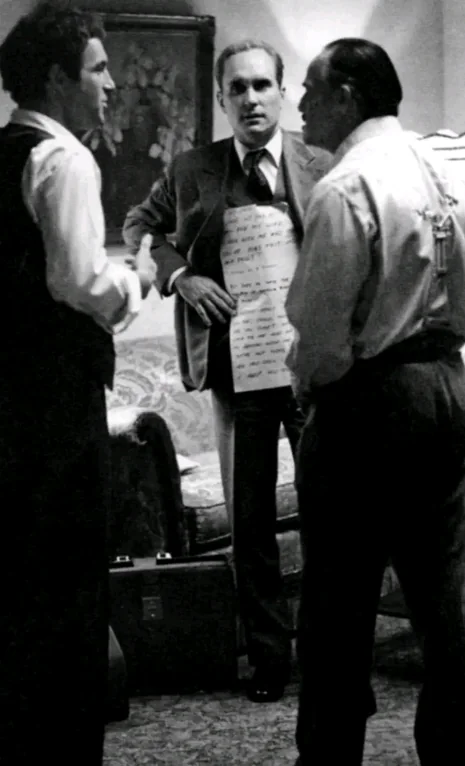
I believe that memorizing lyrics accomplishes a few things:
- It’s much easier to be authentic. When you know the lyrics by heart, there’s one less barrier between you and the audience. You can focus on how the words feel, rather than what they say.
- It’s much easier to display authenticity. Display is performance. You can look the audience in the eye, or glance around the room. You can close your eyes when everything gets quiet and the room feels like it’s floating. And when you’re doing that, you don’t have to think, “okay, now what’s the next line?”
- You have more freedom to play around. You can throw in extra words, and maybe you’ll find one that you really, really like. You can change your phrasing or pronunciation. You can stop the song suddenly and go on a big rant about gas station bathrooms without worrying about losing your place (I have done this; it was not a great rant).
- You can enter a flow state. Flow states create that aforementioned feeling of floating, where afterwards you go, “hey, did I really just do that?” This happens because you’re able to be in the moment, not ahead of the moment (looking at the next lyric).
There’s also this to consider: You may not need to look at your lyrics right now, without reading any further.
Yes, you might have already memorized your songs.
I’ve met more than a few exceptionally talented folks — in some cases, players who are far, far better than me — who read off screens.
I’ve watched those folks carefully, and I’ve noticed that they don’t even really read. Just as their hands move automatically from chord to chord, their mouths move automatically from word to word.
They just want the lyrics there as a security blanket.
And I totally get that.
Because when you screw up lyrics, it’s mortifying.
My worst mess-up was at the Leonard Cohen tribute show at Off Broadway in St. Louis, shortly after Cohen died (always a good time for tributes).
We threw together a group with like 12 people, including string players from the Rats & People Motion Picture Orchestra. Brien of R&P is a huge Cohen fan, so he chose some deep cuts, and we were able to put together a set that we were really proud of.
This is my excuse to embed an R&PMO video. These guys do all-original scores for silent films, and it’s one of the coolest things in St. Louis. When I try to tell people about why St. Louis is a great city, this is one of the three things I mention when making my point.
But Leonard Cohen lyrics are dense, man, and you have to get every single word right. I only knew one of the songs in our set by heart when we signed onto the gig, and we only had a couple of weeks — and a single practice, in the green room of the venue on the night of the show — before the performance.
I messed up the very first song, which I’d thought was the easiest one.
And when you’re playing with musicians who read sheet music, they cannot simply wait for you to remember your line. They keep playing.
So now the verse was going, and I wasn’t singing, and I remembered the first line, but that didn’t help because we were now on the fourth line, and…yeah, it was a disaster.
So I just danced for a minute. Basically, I Ashlee Simpson’d it, but without the comforting backing track.
When the song was over, I was dying. It was immediately on the short list of the most embarrassing moments of my life.
The show went on, though, and I didn’t screw up anything else. At the end of the night, we got a ton of nice compliments from people, and I believe they were genuine — we nailed most of our set — but all I could think about was that first verse of the first song.
I still cringe thinking about it, but I wouldn’t do anything differently.
Embarrassment fades, and it’s not the end of the world if you mess up occasionally. I’ll come back to that in just a bit, but first, let’s get to the memorization tricks that I promised I’d provide here.
When I am learning a new song, this is the process I use. There are other processes out there. This is the one that works for me.
1. I write the entire song out by hand, twice.
There’s science to back this up, in case you care. Writing by hand engages the fine motor system and a bunch of other, uh, brain stuff.
It’s demonstrably more effective than typing, because the…hippocampus…look, I mostly just read the headlines. Headline say writing good. Go talk to a scientist if you want to understand why.
But setting the science aside, I like doing this for a couple of reasons.
First, it’s a simple, relaxing first step. I don’t need to think about it. I don’t need to worry about what could go wrong. I just write everything out, by hand, twice. My job is easy.
(If it’s something I wrote, by the way, the draft I made while writing the song doesn’t count. Two new times.)
Secondly, while I’m writing, I also have a chance to spend some time with the song and appreciate it. If I didn’t write it, I can think about why the writer chose certain words, or why they emphasized certain phrases when performing it. That will make me a better writer.
If it’s something I wrote, I can just marvel at how great I am.
2. I break the song into chunks.
Credit to my friend Eric Eng for the terminology of “chunks.” I was calling them sections, but chunks is superior. Chunks is visceral, and that’s what we’re trying to do here.
Usually, the delineations of those “chunks” are obvious; verse 1, verse 2, etc. However, if a verse is particularly dense, I might take a stanza at a time.
If I’m having a bad day, maybe I’ll just take two lines at a time. I take the smallest chunk that I can manage.
At this stage, I stop thinking about what a song means, why certain lyrics work, and so on. This is important. It may sound unintuitive, but I don’t want to think about words when I’m memorizing them.
They are a task, not poetry.
My goal is to get to the point where my mouth will repeat the words while I think about something completely different. For that to happen, I need a lot of repetition. That repetition will get really frustrating if I keep thinking about meaning. I just want to repeat, repeat, repeat (in a structured way).
Of course, certain words are more sonically interesting than others, and we can use that to our advantage. Here’s how.
As I begin repeating the first chunk:
- I look for key words that are especially memorable. I underline them.
- I don’t worry about the connecting words. If I can remember the key word, for now, the connecting words will come through.
- On a separate sheet of paper, I write down just the key words that might trigger my memory into remembering the entire line.
From here, I keep repeating the first segment until I can sing it without looking at the paper.
I will repeat it in various ways to keep it interesting — I’ll sing it, say it, say it really fast, say it as if I’m in conversation with someone, and so on.
3. I move on to the second segment.
The process is the same for the second segment.
When I think I’ve got the second segment down, I start singing or saying the first segment and then go into the second segment.
When I add two parts together, I’ll inevitably screw up part of the first segment, because I’ve been so focused on the second.
That’s totally fine and I don’t beat myself up about it. The important thing is to pay attention to what I’m screwing up, and write down the words that I’m stumbling on.
So now I’ve got another piece of paper, where I’m writing down the problem words.
I repeat the process for each other section of the song. Crucially, I don’t let myself get frustrated at any point.
You can control frustration, especially if you’re doing something artistic; shut it down and treat memorization as a game. If you can’t help but feel frustrated, take a break, but don’t give up.
Believe in yourself. I know how corny that sounds, but your brain will eventually figure it out. Brains are built for this kind of thing.
4. When I think I’ve got it all down, I try to perform it for myself in a few ways.
First, I try to recite all of the lines really, really quickly.
That will expose additional weak points (which are often the same weak points that I already knew about). If I screw a line up, I’ll hyperfocus on that line for a few seconds, just repeating it over and over.
If I stumble on one word, I’ll repeat just that word a few times. I want it to feel good in my mouth (and I am so, so sorry for the word choice here, but it’s the most accurate description of what I’m doing).
By this point, I’m not thinking about the words as actual words. They’re a collection of sounds that I have to put in the right order. Ironically, this will let me engage more with the lyrics when I eventually perform the song — but before I get to that point, I want to know the song by heart, and I want my brain to be completely out of it.
When I feel like I’m at that point, I’ll perform the song with my final cheat sheet, which has just the key words from each line to guide me. It looks like absolute madness.
I try to avoid looking at the cheat sheet as much as possible. If I can perform the song without feeling like I’m reaching for any of the words, I’m good.
But if I have to think at all before singing a line — even for a microsecond that doesn’t disrupt my playthrough — I repeat it again.
We’ve gone a while without a media element, so here’s the song Repetition. You don’t have to listen to it.
Why? Well, I don’t want to scare you, but it’s important to know that any minor issue in practice will become a bigger deal in a life performance. If you’ve got a whole song down, but every third time you mess up one line, you will forget that specific line when you’re in front of people.
You can fix that! Pay attention to your weak points and practice until they’re as solid as your strong points.
5. I keep the stakes low for the first performance.
I’m stealing this metaphor from somewhere, but which would you rather do: Walk across a 2X4 on the ground, or walk across a 2X4 suspended between two skyscrapers?
The act of walking is exactly the same, but when the stakes change, the task is much more difficult. Anxiety makes things worse.
So: Don’t make things any harder than they need to be. Head to an open mic, where mistakes aren’t a big deal.
I’m very comfortable with the open mic on Sundays at the Stagger Inn in Edwardsville, Illinois, so that’s where I try out most of my new songs. If I have a dinner gig (meaning a gig where nobody’s paying attention, ‘cause they’re eating dinner), that’s a great place to try new material.
If an open mic is too intense, play it for a person you trust. Find a setting where failure is okay, because you’re probably going to screw something up, and that’s just part of the process.
I always assume that the first performance will be subpar.
In my experience, this is always true. The first playthrough is always is a little off. I’m nervous because I’m trying something new, and I’m not having a lot of fun, so yeah, I’m gonna mess up.
In fact, I hate performing a new song for the first time. But I love performing a new song for the second time, so I’ve got to get that first one out of the way.
If I’m able to get through it without stumbling or reaching, I know that I’m in good shape. I will have about 80% less anxiety on the second performance, and then 80% less than that on the third performance, and eventually I’ll be totally phoning it in like Billy Joel.
Even if you get really, really good at memorizing lyrics, you’ll still occasionally screw them up.
It’s just part of the gig, and it’s gonna happen. Here’s the good news: If you mess up, you will care more than anyone else.
The audience will never care that much when you forget a lyric. You will feel stupid, of course — and yeah, it can be mortifying, especially if you find yourself dancing in front of a confused crowd to a suddenly-instrumental Leonard Cohen tune.
When that happens, just laugh at yourself and move on.
Remember why you’re trying to memorize words in the first place: When you know your songs by heart, you can safely disengage your brain while performing them. You can look around the room and think thoughts that have nothing to do with the lyrics.
I feel that it’s a profound experience, and I’m writing this whole thing because I want you to have it, too.
Trust that your brain has this ability. It probably does, unless you’ve been diagnosed with something (and even if you’ve got something like ADHD, memorization is still possible, though you may need different techniques).
You have the ability to memorize lyrics.
Relax and trust yourself. Try to be patient, and work the process slowly. If you get frustrated, take a break.
And I want to reiterate that you’re not any less of an artist if you read off of a screen or a pad of paper. We’re songwriters because we write songs, after all, and the most important thing is that you are happy with how you perform.
But if you do want to memorize lyrics, I think this process will help.
It works for me, anyway.
If you’ve got additional tips, please share them in the comments below (I get crazy bots on this page, so I have to approve comments manually, but I’ll do it as quickly as I can).
Also, I’m able to write this today because I’ve got, uh, extra time at the moment.
I am a writer by trade, and AI is decimating my profession. If you found this useful, please consider buying one of my recordings or donating directly via Paypal or Venmo.
Or better yet, shoot me a message if you’ve got a business that needs content that isn’t slop from a plagiarism machine.